The benefits of knowing HTML

A recent interview with the design director of NYTimes.com revealed something wonderful, they still write their HTML by hand.

It’s our preference to use a text editor, like HomeSite, TextPad or TextMate, to “hand code” everything, rather than to use a wysiwyg (what you see is what you get) HTML and CSS authoring program, like Dreamweaver. We just find it yields better and faster results.

Hell yeah, it does.

The nerds can get a bit macho about their coding skillz, as can be witnessed in the comments thread over at LifeHacker, but don’t be fooled – HTML is not just for 21st century gearheads.
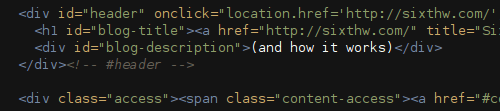
Sixth W, in HTML

Why we care

It is nearly impossible to write tight code with software like Dreamweaver unless you’re already a HTML guru. But so what, as long as it looks pretty, it’s fine, right?

Wrong. A well-coded site loads much faster, is easier to maintain and will be more findable by search engines. The files will be smaller, keeping your hosting costs down because you’re using less bandwidth.

Plus you don’t have to buy all that software! The finest text editor on the market, TextMate, costs $63. Dreamweaver costs $399. I use the very simple gedit, a free and open source text editor for Linux, and Windows users have the excellent and also free Notepad++.

Finally, even if you are just writing a blog (or using any other content management system), a knowledge of some basic HTML will make an enormous difference in the visual consistency of your work.

A BMW and a Pontiac aren’t all that different – except in the details. Users notice build quality, even if they’ve got no idea what’s going on under the hood.

If I’ve sold you

Jeffrey Zeldman’s fantastic book Designing with Web Standards is the best place to start. Zeldman explains the benefits of good code in a elegant, human-friendly fashion.

Then, once you’re drinking the kool-aid, pick up Web Standards Solutions: The Markup and Style Handbook by Dan Cederholm. It’s jam-packed with clear and pragmatic examples of well-written HTML.

And once you’re swinging a mean axe, A List Apart will make you stronger, faster, and more powerful.

Beautiful new media storytelling

We Tell Stories is a project from Pengiun: six new stories inspired by six classics, all told using new media techniques like blogging, mapping, and infographics. – totally freakin’ neat.

Over six weeks writers… will be pushing the envelope and creating tales that take full advantage of the immediacy, connectivity and interactivity that is now possible. These stories could not have been written 200, 20 or even 2 years ago.

Ideas are travelling faster

Journalists should care about net neutrality

If you value the free dissemination of ideas – if you believe that democracy requires a free press – if you prefer truth to truthiness – you should care about network neutrality.

First, the ever helpful sports metaphor.

You’re watching a Cubs game. It’s a nail biter – in the bottom of the ninth, your favorite slugger steps up to the plate, and the image goes wonky. From HD-sexy to YouTube-chunky. And the pitch! The audio goes crunchy. The video stops. You miss the home run.

Why did this happen? The Cubs are on WGN. Your cable provider, Comcast, has a competing sports channel that had just begun airing the White Sox game. Comcast dialed down the quality of WGN to give their channel more bandwidth, so that it would come in crystal clear.

Cubs fans run amok. The bars on Clark Street empty into the streets. Riots. Human sacrifice. Dogs and cats living together. Mass hysteria! (Best. Movie. Ever.)

If only the network were neutral, all of this would have been avoided.

What is network neutrality?

Lawrence Lessig and Robert W. McChesney defined it well in their piece for the Washington Post.

Net neutrality means simply that all like Internet content must be treated alike and move at the same speed over the network. The owners of the Internet’s wires cannot discriminate. This is the simple but brilliant “end-to-end” design of the Internet that has made it such a powerful force for economic and social good: All of the intelligence and control is held by producers and users, not the networks that connect them.

Why should I care?

The Comcast example is totally plausible. Cable television doesn’t *quite* work how I described, but the Internet certainly does. And it’s happening right now!

Neil Berkett, the new CEO of Virgin Media (my ISP at home in London, along with BT) has announced that he considers Net Neutrality to be “a load of bollocks” and he’s promised to put any website or service that won’t pay Virgin a premium to reach its customers into the “Internet bus lane.”

What a jackass! The Internet is amazing because it lets all voices be heard. If this bozo gets his way, new media will become a tool of corporations. Citizen journalism and non-profit media are toast. No money? No speech.

And this applies to everything you do online: reading the news, listening to music, downloading porn, and calling grandma on Skype. I don’t know how to better put it. This is very important.

For more, check out Save the Internet, Tim Wu’s excellent network neutrality FAQ and my friend Adam Verwymeren’s blog on net neutrality, A Series of Tubes.

UPDATE:

The Huffpo has an excellent piece about recent news that the MPAA and RIAA are working together with the ISPs to stifle net neutrality, under the guise of piracy prevention – don’t miss it.

Citing piracy concerns, Big Media has made its deal with broadband ISPs like Comcast to make sure its Internet video gets priority A-1 Express Lane carriage over the Internet. In exchange, they are supporting the ISPs’ fierce opposition to net neutrality rules that would bar them from pushing everyone else’s video into the Bus Lane, if they even deign to deliver it at all.

The new arms race

A new arms race is on, but its not being fought between the usual players. Media outlets, nationalist groups, coders, and governments are all fighting to control the flow of information.

Some news from the front:

Russia bearing down

Government efforts to block access to websites like The Great Firewall of China are at this point well-known. Now it looks like Russia is getting into the game.

An official at the Russian prosecutor’s general office, Vyacheslav Sizov, told the Russian-language newspaper Rossiiskaya Gazeta that any web site that is determined to host what he terms “extremist material” would be blocked from being accessible from within the Russian Federation. Given the Putin government’s history with the media, “extremist material” may be very broadly interpreted as any content unfriendly to the interests of the Russian government.

This comes fast on the heels of the news that Rossvyazokhrankultura (the Russian Mass Media, Communications and Cultural Protection Service) will require registration of any Wi-Fi device, including hotspots, mobile devices, laptops, and home networks.

Rossvyazokhrankultura’s interpretation of current law holds that users must register any electronics that use the frequency involved in Wi-Fi communications, said Vladimir Karpov, the deputy director of the agency’s communications monitoring division.

Though here is no guarantee that Wi-Fi registration will be used to censor the news, it most certainly could be.

For more on censorship and how efforts to dodge it, see my recent post on Internet censorship.

Chinese nationalist groups attack

Before the web, it was very difficult to shut down a news source half-way around the world. Now all an attacker need do is exploit a flaw in the code of a website, convince an unsuspecting employee to hand over the keys, or if all else fails, just beat the living crap out of the website by flooding it with requests.

In recent weeks, Chinese attackers have tried, with some success, to take down at least three western websites because of content sympathetic to the movement for Tibetan independence.

Most recently, presentation sharing site SlideShare was hit with a huge distributed denial of service attack. Before that, a denial of service attack on CNN mostly failed, and around the same time an attack on a site mistaken as CNN-related, SportsNetwork, was more successful.

Beijing backs off

Though many suspect that the Chinese government is at least indirectly supportive of the recent attacks, the Wall Street Journal reported Thursday that they are now suppressing online nationalist fervor to save face before this summer’s spandex extravaganza.

It is a familiar pattern: Chinese nationalism rears up, sometimes with what seems to be tacit government backing, only to get reined in before it threatens to spin out of control — in this case, before it can mar preparations for the summer Olympic Games in Beijing.

Though this is *slightly* comforting, in no way do I expect this trend to continue.

Remixing the web: users taking back control of their media

Lifehacker just posted a bit about a new Firefox extension that changes how Craigslist works. There are a mess of extensions for Firefox that do stuff like this. (My personal favorite blocks annoying flash and banner ads.)

Craigslist Image Preview adds a thumbnail of the image(s) within a listing on Craigslist without requiring you to click through to the actual page. Since most Craigslist ads live or die by the included image of what’s actually being sold, this extension saves a ton of time and is a must-have for any Craigslist shopper.

Craigslist image preview plugin

In my mind, this fits in the same category as RSS feeds, podcasts and Tivo. Users are gaining the ability to absorb media at their own pace and in the format they prefer.

What made it possible? Open standards, like HTML and RSS, and open systems like Firefox’s add-on framework. This would never have happened on a proprietary system. You can’t do this to Microsoft Office.

Craigslist just got more useful, and it didn’t cost Craig, or you, a dime.