More great reading, NYT and locative media

Google Earth, New York Times Team Up

You can now browse New York Times news based on geography. Has the New York Times become hyperlocal, even though the content may not have that perspective. if all goes according to plan, the news will be updated every 15 minutes.

The Center for Locative Media

As educators and amateur neo-geographers, we found a rich vein of place-based pedagogy to tap into. Here story was already married to place. As technologists we watched the tools become available to not only tag content to place, but to experience it in that place.

On second thought, forget Google, make your own maps

Latest news in Ravenswood on EveryBlock

Paul Smith from EveryBlock has written an excellent article on making your own interactive maps.

An ecology of open source online mapping tools has emerged alongside the market leader. It is now possible to replicate Google Maps’ functionality with open source software and produce high-quality mapping applications tailored to our design goals.

The folks over at A List Apart have this knack for publishing articles that I come back to again and again. I think this one will be another on that list.

YouTube videos now on Google Maps

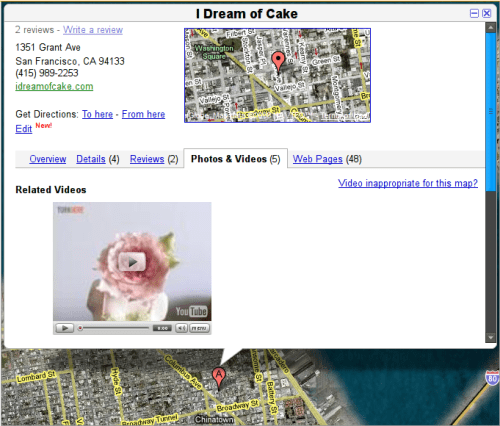
Mashable has posted a nice analysis of the newest feature of Google Maps, YouTube videos.

The new feature is slightly different from geotagging photos in Flickr or Picasa, and is also different from the YouTube videos you can find in Google Earth. In those cases, a photo or video is associated with a particular geographic location. The new feature of Google Maps applies to particular listings (businesses, etc.) that appear on the map.

An Example of YouTube video on Google Maps.

Great map integration is one of the reasons Yelp kicks the tar out of Metromix here in Chicago, and is the killer feature of Everyblock. How great would it be if Check, Please! reviews were attached to the restaurant listings?

Or if local news channels could hang their videos off of places and you could see the evening news presented in order of nearness to places important to you: mom’s house, the elementary school, where your son is fighting in Iraq.

Geography is important. This little feature of Google Maps isn’t much, but it’s a glimmer of a new way news and place could interact.

AP, Microsoft to share member videos in tiny, useless web interface

The Associated Press announced it will allow AP members to post videos to their Online Video Network for sharing with others. Previously, the content supply was one-way, from the AP only. Microsoft and the AP are partners in the OVN, and will share ad revenues with members that supply the videos.

Unfortunately, it seems that by working with Microsoft, the AP has hobbled their efforts. The video is streamed in the increasingly abandoned Windows Media format, instead of the ubiquitous Flash Video, presumably by Microsoft’s choice.

Adding insult to injury, the widget that AP members put on their web sites to host the videos does not appear to work in Firefox on Mac, Windows, or Linux. It does seem to work in Safari on Mac, and of course it works in Internet Explorer.

Actual size:

Associated Press video widget

The AP justifies this choice on their Browser and Platform Compatibility page, saying that “If a user attempts to access the OVN while using Mozilla’s Firefox (8 percent share), Apple’s Safari (2 percent), AOL’s Netscape (2 percent), or Opera (<1 percent) they will likely be unable to launch and/or properly view the video player. The primary reason for this incompatibility is that the Microsoft’s video player (on which the OVN is built) requires the use of ActiveX controls – a technology that these browsers don’t support.”

By their numbers, 13 percent of web users don’t matter. By better numbers, 22 percent don’t matter. How many people they are dismissing varies by who you ask, but it’s undeniably a lot of folks.

But it doesn’t really matter because the text is so tiny, it’s hard to imagine anyone reading the title of a video and clicking on it before it scrolls away. And if that was not enough to deter viewers: If you’re lucky to be an Internet Explorer user with a magnifying glass and fast hands, you still have to wait through a 30-second commercial before you can watch the video.

Try it for yourself. I hope that the member sites are ready for the deluge of ad revenue.