Better online video for news: Short movies = long pictures

Today’s great post from Mindy McAdams reminded me of some thoughts I’ve had recently about online video. News organizations are trying too hard! There’s an easier way to tell video stories on the web.

The web is not TV

Television news has gotten us used to a specific format of video. But a TV piece doesn’t make much sense on the web, especially when you’re accompanying a written story. I don’t need an intro, talking heads, or scrolling text updates online. I’m already reading the story! All I want is the payoff.

Show me the gaffe. The explosion. The kid saying something adorable. I don’t want to see a reporter, or your logo, an ad or anything else. Just the goods. Use video when words fail to capture the moment.

http://www.cnn.com/video/savp/evp/?loc=dom&vid=/video/politics/2008/10/21/sot.palin.role.as.vp.cnn

This bit from CNN.com does it right. News videos are usually a separate piece from the written article, this one is the exception to the rule. (Compare to this other piece from CNN.com.) The videos cut to the chase and go straight to her dialogue — they are an interesting accompaniment to the story.

But wouldn’t they be more effective embedded directly into the story, as illustrations? Couldn’t we treat videos like photos in a magazine? Instead of using video as an alternative to reading, use it to punctuate ideas.

Enter the long picture

When Flickr introduced video support earlier this year, their photo-loving users flipped. To calm them down, Flickr suggested that the community thought of them as “long photos.” By limiting the time of a video to 90 seconds, they encouraged brevity and simplicity of production.


& by striatic

Blurry, short, and fan-freakin-tastic

12seconds and Seesmic are already thinking this way, but about conversations. They show us something very important: Video doesn’t need to be perfect to be compelling. Watching John Cleese and a little girl have a conversation is totally great even if the video is brief and grainy.

Re: Ella /: John Cleese on Seesmic Tuesday 7th at NOON Pacific Timehttp://seesmic.com/embeds/wrapper.swf
Re: Ella /: John Cleese on Seesmic Tuesday 7th at NOON Pacific TimeThanks John! http://seesmic.com/embeds/wrapper.swf

You don’t need videographers

I’ve found the sweet spot length of a video is under a minute for sure, and I’ve been quite happy with videos eight to twelve seconds in length. With a video that short, folks don’t really care if the camera shakes or if it’s a little fuzzy. And you don’t need to edit it! Just shoot a bit of video, upload and embed.

And the gear couldn’t be simpler. My $300 Panasonic TZ5 digital camera takes great pictures and shoots *HD video*. Plus it’s got image stabilization and a mother of a zoom lens. Or you can keep it super simple and pick up a Flip – they’re cheap and do a great job. (I shot the video embedded above on my TZ5. For more examples, check out my Long pictures set on Flickr.)

This is simple stuff. You don’t need expensive equipment or a video production team. News organizations are already encouraging their reporters to take photos — why not ask them to shoot a bit of video too? It doesn’t need to be perfect to tell a great story on the web.

Creating real-world social constraints with Facebook Connect

In our efforts to increase connections among the fine citizens of Cedar Rapids, Team Crunchberry has decided to integrate our efforts with a cool-as-hell new way to leverage social networks, Facebook Connect.

Facebook says Connect will enable users to:

  • Seamlessly “connect” their Facebook account and information with your site
  • Connect and find their friends who also use your site
  • Share information and actions on your site with their friends on Facebook

Connect with Facebook

By clicking on a button like the one above, you’ll be automagically logged in to our site!  This enables us to do some very interesting things, as I wrote about on the Crunchberry blog:

Besides lowering the mental overhead of forcing a user into signing up for yet another account, we’ll be able to play with real, established social networks. (And without expecting folks to set up a friends list on a site that none of my friends use!)

For instance, when a user makes a comment, we’ll push it to their Facebook feed. Will you be more likely to comment if you know your friends will see what you have to say? Will you be less likely to act like a jackass?

A little Face(book) to Face(book) chat

We’re betting that we can increase the quantity and quality of conversations by bringing them into to your network.  Why would I comment in a vacuum?  I want my friends to hear what I have to say.  And when they do, maybe they’ll back me up.  And since I’m being heard, maybe I’ll think twice before being a jerk.

Yay, props!  Yay, shame! It’s almost like a real world argument.  All we need now is a pitcher of beer and a table to pound on. Is there a django plugin for that??

Building a news product with agile practices: How we’re doing it

The Crunchberry Project is using agile software development practices as we build a new product for the Cedar Rapids Gazette.  On the team blog, I’ve begun writing a series of pieces detailing our process.

Part one was a brief attempt at defining agile and explaining why it’s important:

What can happen in a year?  Twitter catches on.  The stock market crashes.  Your competitor releases a new product.  A new congress is elected, and they change the laws.  It’s discovered that margarine is healthier than butter.  Your business model becomes obsolete.  And you’ve invested nine months in a product that nobody needs anymore.

And let’s just say that you’re living in a time warp, and the world remains completely static, who’s to say that you even got the requirements right in the first place?  If you’re wrong, you just invested a year of work in a system that doesn’t work for your users.

As a great Chicagoan once said: “Life moves pretty fast. If you don’t stop and look around once and a while, you could miss it.”  Your requirements will change.  Agile teams are prepared for the chaos.

Part two in the series begins to explain how our team is implementing agile processes: how we meet, the weekly atomic work cycle known as an iteration, and why we think meetings are toxic.  Plus, it’s got a great parenthetical reading list:

(… If you want to do this right, read Agile Software Development, Principles, Patterns, and Practices by Robert C. Martin, and The Pragmatic Programmer, by Andy Hunt, and Dave Thomas.  Or even better, go to Ann Arbor and learn it from the badasses at The Menlo Institute.)

(Also, read Getting Real by the folks at 37signals.  Please, just trust me on this one.  It’s important.  Much more important than reading this silly blog post, that’s for sure.)

In the upcoming weeks, I’ll be sharing our design process, task and defect tracking, how we test, and lots more.  Stay tuned!

NYT releases Campaign Finance API

As announced on Open, NYT’s open source blog:

The upcoming presidential election has seen record fund-raising by the candidates and a host of new donors. Now we want our users to be able to analyze and reuse some of the data we’ve been looking at while reporting on the campaign.

Read Write Web’s take is on:

One thing that big media still does have a particularly good share of, though, is information processing resources and archival content. The Times’ campaign contribution API is a good example of this. The newspaper is far better prepared to organize that raw information, and perhaps offer complimentary content, than any individual blogger or small news publisher. …

When developers create applications that use their data, the Times will once again assert itself as an essential part of our information landscape – both in mind share and in inbound links/Search Engine Optimization for their online content.

Outstanding.

Creating community connections in Cedar Rapids, Iowa

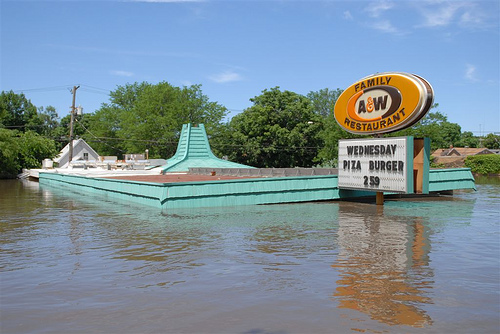
Cedar Rapids, Iowa was hit with one of the worst natural disasters in U.S. history this June, when the Cedar River rose past it’s 500-year flood plain to 31.2 feet, flooded 1,300 city blocks, and put most of the downtown area under water.

When we visited the Gazette, Cedar Rapid’s daily paper a few weeks ago, the city was still soggy.  The streets were lined with discarded appliances and stacks of rotten home remains — though we were reassured that things looked *far* better than a few months ago.

A&W on Ellis Blvd. by justj0000lie

It is in this setting that my final project at Medill began.  Our team of six budding new media journalists, under the guidance of instructors Rich Gordon and Jeremy Gilbert, has teamed up with the Gazette to create something for their community.

Our mission?  To build and strengthen connections among 20 to 35 year olds in Cedar Rapids.

Rich’s take:

The decision to target young adults was sensible, given their heavy use of digital media. Still, I think it also increased the “degree of difficulty”…. Local media companies have had some success creating online products geared to this audience, but they have usually revolved around entertainment….

This week comes the hard part: settling on the core idea for the students’ innovation. What kind of site or service will they try to build? How will this site or service connect young adults in eastern Iowa? What role will news or journalism play?

I’ve got a feeling that the next ten weeks are gonna be frantic and fascinating.  If you’re interested in following along, we’re recording our experience over at the Team Crunchberry blog.

Crunchberry?

In honor of the berry-riffic scent that wafts from the Quaker Oats plant through downtown Cedar Rapids, we named our team after a certain breakfast cereal that’s close to all our hearts.  If we can continue making champion decisions such as this one, we’re destined for success.